
What Continuing Competence Requirements would look like if created in every state.

The Core Framework (All States)
A true continuing competence system — separate from professional development — would require every state to do four things differently (or our professional associations can do this together like they worked on the Entry Level Analysis Project together):
1. Research first, requirements second. Before any state mandates competency maintenance, it needs to identify: What specific knowledge gaps correlate with disciplinary actions or client harm in massage therapy? No state currently has this data. Building it is step one.
2. Assess competence, don’t just count hours. The current system counts seat time. A competency-based system would require practitioners to demonstrate knowledge — through pass/fail assessments with identity verification — in the specific areas tied to public safety.
3. Separate regulatory from developmental requirements. State boards handle public safety. Professional associations handle career growth. Never the same bucket.
4. Publish what works. Every state would be required to publish effectiveness data: Are disciplinary actions declining? Are client complaints decreasing? If the requirements aren’t producing measurable results, they get revised. (The main problem that most boards deal with are ethical issues and usually not injuries to clients.)
What the Competency Assessment Would Cover (All States, Core Module)
Every licensed massage therapist, in every state, would demonstrate current competency in:
Ethics & Professional Boundaries
Scope of practice for their state
Informed consent and draping standards
Mandatory reporting requirements
Recognizing and responding to boundary violations
Contraindications & Client Safety
Current evidence on contraindications (updated, not based on 1990s textbooks)
Red flags that require medical referral
Communicating limitations and scope to clients
Adapted techniques for special populations
Hygiene & Infection Control
Current public health standards
Bloodborne pathogen protocols
Sanitation requirements specific to their state
Legal & Regulatory Updates
Any changes to state law since last renewal
Human trafficking awareness and reporting (now required in many states)
Trauma-informed practice basics
Assessment format: Online, proctored, 50–75 questions, minimum passing score. Not a no-fail survey — an actual test. Multiple approved providers compete on quality and price.
Frequency: Every 2–4 years at license renewal (aligned with current renewal cycles). Cost cap: No more than the equivalent of 2–3 hours of work at the state’s median massage therapy hourly rate.
(After a certain number of years and with no violations, the CC requirement would most likely be reduced to zero. )
State-Level Variations (Flexibility Within the Framework)
While the core module is universal, states would be permitted to add one additional competency module based on documented local need:
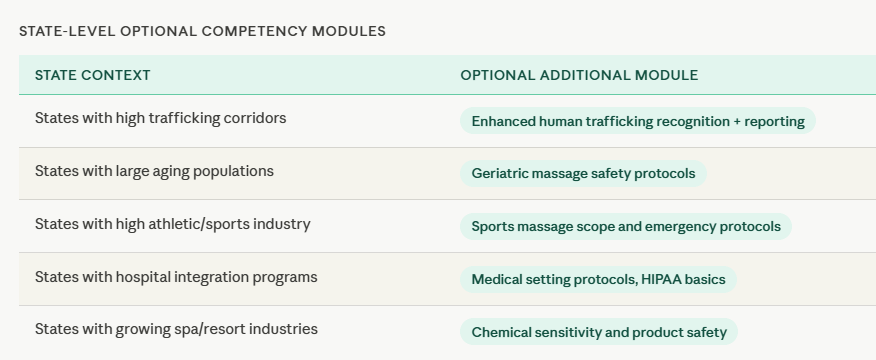
These modules would be based on documented harm patterns in that state — not added arbitrarily.
What Would NOT Be Required (By Any State)
Under a true continuing competence model, the following would not count toward licensure renewal:
Technique workshops (hot stone, Thai, bamboo, etc.) — these are professional development, not competency maintenance
Modality certifications or specialty courses — same reason
Business development courses — professional development
Any course not directly tied to the entry-level safety competency framework
Courses from providers who cannot demonstrate evidence-based content
These aren’t bad courses. They just belong in a different system — the voluntary professional development system run by professional associations.
What Professional Associations Would Build Instead
With regulatory CE requirements stripped down to what actually serves public safety, professional associations (AMTA, ABMP, specialty bodies) would build the professional development infrastructure the profession actually needs:
Specialty Certification Tracks (voluntary, recognized by employers and insurers)
Clinical/Orthopedic Massage
Oncology Massage
Sports Massage
Prenatal & Perinatal Massage
Hospital-Based Massage
Pediatric Massage
Geriatric Massage
Formal Mentorship Programs
New Graduate Mentorship (first 1–2 years of practice)
Specialty Apprenticeships
Business Mentorship for Solo Practitioners
Master Practitioner / Mentor Designation
Research Literacy
Science literacy courses
Evidence-based practice integration
Journal clubs and peer learning circles
Business & Career Development
Solo practice development
Employment navigation and workers’ rights
Leadership and advocacy training
The Timeline: What Implementation Could Look Like
Year 1–2: Research Phase
Commission research on what knowledge deficits correlate with harm in massage therapy
Survey disciplinary records across all state boards
Identify the specific competency gaps that regulations should address
Year 3–4: Pilot Phase
3–5 states pilot the competency assessment model at renewal
Multiple providers compete to develop assessment tools
Costs, pass rates, and practitioner feedback documented
Year 5+: Nationwide Rollout
Remaining states adopt model based on pilot results
Professional associations launch formal development frameworks
Effectiveness data published annually and used to refine the system
Why This Hasn’t Happened Yet
The honest answer: MONEY and inertia.
The CE approval and delivery industry generates significant revenue. Organizations like NCBTMB and FSMTB have built infrastructure around the current system. Professional associations use CE as a membership benefit. State boards have invested in approval processes.
Changing the system means disrupting established revenue streams — even when the evidence (or lack of it) clearly supports change.
That’s why this conversation has to happen at the practitioner level first. When enough therapists understand what the system is supposed to do — and how far the current system falls short — the pressure for reform becomes impossible to ignore.
That’s what this series is about.
Understanding Continuing Competence in the Massage Therapy Profession An examination of the evolution, controversies, and future directions of professional development requirements for massage therapists
The Massage Profession’s $252 Million Mistake: Why We’ve Been Confusing Competence with Development for 30 Years
How fixing this one confusion could transform the entire profession.
A New Model for Maintenance of Competence Evidence-Based, Practitioner-Centered, and Focused on Actual Public Safety