In January 1996, something unusual but amazing happened in Washington State.
Washington and specifically the insurance commissioner at the time (Deborah Senn) did something that was remarkable for its time.
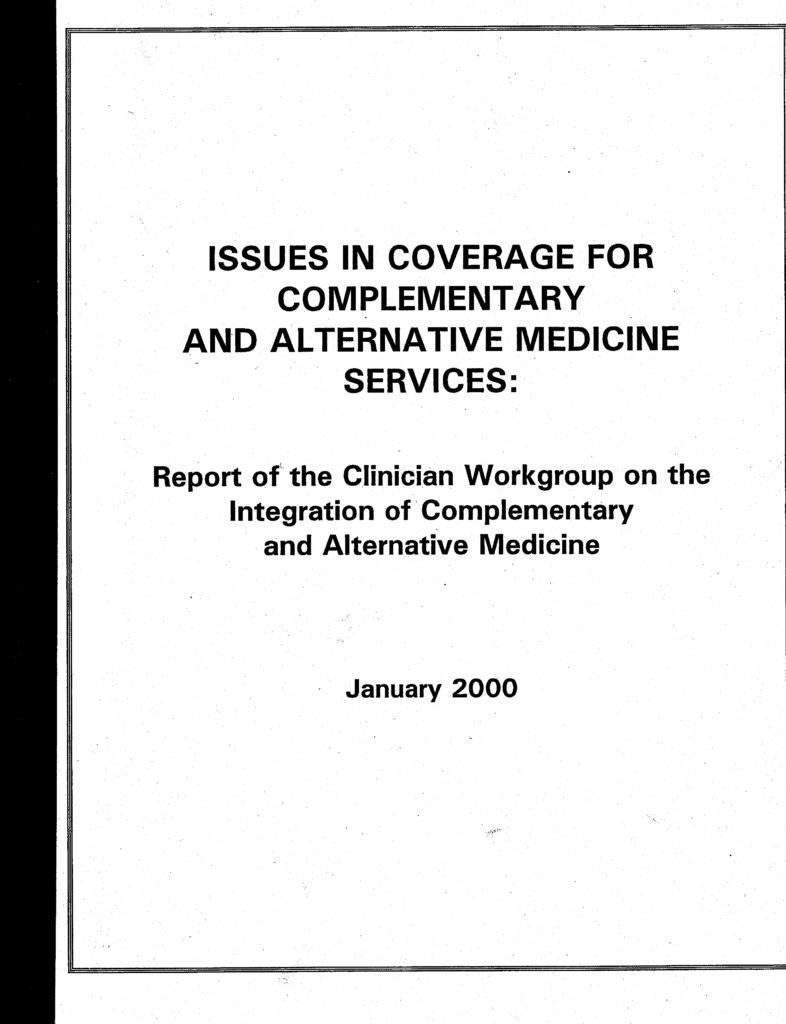
It told state-regulated health insurers that they could not simply exclude an entire category of licensed health care provider when that provider was legally qualified to provide care for a condition covered by the plan. The whole story is chronicled in a booklet titled From the Report of the Clinician Workgroup on the Integration of Complementary and Alternative Medicine January 2000. Washington State found on my website.
That included massage therapists.
It became known as Washington’s Every Category of Provider law, RCW 48.43.045.
Thirty years later, Washington’s experience raises a question that deserves far more attention from the massage profession:
If Washington found a way to bring licensed massage therapists into the private health insurance system in 1996, why didn’t this spread across the country?
The answer is more complicated than I expected.
It Began With Washington’s Attempt to Reform Health Care
The story actually starts before 1996.
In 1993, Washington adopted a sweeping Health Care Reform Act. One of its stated goals was to provide access to essential health and medical services from health care providers licensed by the state.
Much of that larger reform effort was later changed or dismantled.
But one important idea survived.
In 1995, the Legislature enacted what became RCW 48.43.045. Beginning January 1, 1996, health plans subject to the law were required to permit every category of licensed health care provider to provide covered health services when those services fell within that provider’s legal scope of practice.
That distinction is important.
The law did not say that every insurance policy had to cover massage therapy for everything. It essentially said that if a plan covered a health condition or service and a category of licensed provider could appropriately provide that care within its scope of practice, the insurer could not simply eliminate the entire profession from consideration.
Washington’s current regulations still use low back pain as an example. If outpatient treatment for low back pain is covered, a category of licensed provider that can provide cost-effective and clinically efficacious treatment within its scope cannot simply be excluded as a category.
The Washington Office of the Insurance Commissioner still specifically identifies massage therapists as providers protected by the Every Category law.
For massage therapy, this was extraordinary.
The Insurance Industry Fought It
The law did not take effect quietly.
The chronology preserved in Washington’s 2000 Report of the Clinician Workgroup on the Integration of Complementary and Alternative Medicine tells a remarkable story.
In August 1995, the Insurance Commissioner asked insurers to explain how they intended to develop networks capable of complying with the new law.
By December, the Commissioner had issued an interpretation of the statute.
On January 8, 1996, carriers went to court.
That began several years of litigation over what the Legislature had actually required and whether federal law preempted Washington’s attempt to regulate employer health plans.
The dispute moved through state court, federal court and eventually the Ninth Circuit Court of Appeals.
Initially, insurers won an important federal ruling based on ERISA, the federal law governing many employer benefit plans.
Washington appealed.
In June 1998, the Ninth Circuit reversed the lower court.
The insurers sought rehearing and lost.
They then petitioned the United States Supreme Court.
In January 1999, the Supreme Court declined to hear the case, leaving the Ninth Circuit decision standing.
Washington’s law survived.
The Washington Supreme Court later also addressed the breadth of the statute in Hoffman v. Regence BlueShield. The court noted the statute’s broad language requiring covered plans to permit “every category of health care provider” to provide covered services.
This was not some minor insurance regulation that slipped through unnoticed.
It was contested.


Then Washington Had to Figure Out What the Law Actually Meant
Winning the legal battle did not solve the practical problems.
How do you integrate professions that insurers historically had not included in conventional medical networks?
What standards can an insurer impose?
Can an insurer limit visits?
Can it require referrals?
Does every individual massage therapist have a right to join every network?
Washington eventually developed rules answering many of these questions.
Insurers can use restricted networks. They do not have to contract with every individual provider. They can impose reasonable limits and require providers to meet legitimate standards for clinical effectiveness, utilization review, administration and cost containment.
What they cannot do is decide that an entire licensed profession is inherently incapable of providing any covered, effective service and exclude the profession on that basis.
That is a much more sophisticated policy than simply saying, “Insurance should cover massage.”
It separates three different questions:
Is the condition or service covered?
Is this profession legally qualified to provide that service?
Does this particular practitioner meet the insurer’s network and credentialing requirements?
Those questions are still useful today.
And Then Researchers Got an Opportunity Almost No Other State Could Provide
Washington had inadvertently created a large natural experiment.
What happens when hundreds of thousands of insured people have access to chiropractors, massage therapists, acupuncturists and naturopathic physicians?
Do people suddenly flood these providers?
Do insurance expenditures explode?
Researchers at the University of Washington and elsewhere eventually examined the claims. A 2006 study looked at more than 600,000 privately insured people in western Washington. About 13.7 percent had a claim involving one of the complementary and alternative provider categories studied.
Massage therapy claims were submitted for only about 2.4 percent of enrollees.
More importantly, complementary and alternative provider care accounted for approximately 2.9 percent of total expenditures.
The researchers concluded that utilization was substantial but its effect on total insurance expenditures was modest. They also observed that insurance coverage had not produced the kind of runaway utilization insurers had feared.
That matters.
One of the obvious arguments against expanding provider access is that everyone will start using the newly covered services and costs will soar.
At least in this Washington population, that did not happen.
Later research produced another interesting result.
Researchers compared insured patients with back pain, fibromyalgia or menopausal symptoms who used complementary providers with matched patients who did not.
Average expenditures were actually lower among the CAM users, although they had somewhat higher outpatient expenditures. Lower inpatient and imaging expenditures offset them. The researchers appropriately did not claim that this proved complementary care caused the savings, but the results certainly did not support the idea that access inevitably produced excessive costs.
That distinction is important.
This research does not prove that insurance coverage of massage therapy reduces total health care spending.
It does show that Washington’s experiment did not produce the financial disaster that opponents of broad provider access might have predicted.
So Why Didn’t the Other States Copy Washington?
This is where the story becomes especially interesting.
I have not found evidence of another state adopting the same broad model.
In fact, a 2006 Washington Senate bill report discussing provider contracting stated plainly:
“This is the only state that has an ‘every category of provider’ regulation.”
Other states have adopted laws requiring coverage of particular professions or prohibiting certain forms of provider discrimination. Chiropractic coverage mandates became common. Acupuncture and naturopathic physicians gained coverage in some states. Individual professions have repeatedly fought for their own insurance provisions.
But that is different from Washington’s approach.
Washington created a general principle applying across licensed health professions.
Why didn’t that become the national model?
There probably isn’t one answer.
1. Washington’s Law Came Out of an Unusual Political Moment
The Every Category provision was part of Washington’s much larger early-1990s health reform movement.
The 1993 legislation contemplated restructuring large portions of the state’s health system. Provider access was only one piece of that effort.
When much of the larger reform program disappeared, the provider provision survived.
That combination of circumstances was unusual and difficult to reproduce elsewhere.
2. Insurers Had Strong Reasons to Oppose It
The years of litigation tell us something.
Insurers valued their ability to design networks and determine which categories of practitioners they would include.
Even years later, Washington legislative testimony concerning provider contracting included warnings about interference with insurer contracting and the costs associated with broader provider requirements.
A Washington-style law shifts some power away from insurers.
Instead of asking:
“Does the insurer recognize massage therapists?”
the law begins with:
“Is this a state-licensed health profession legally qualified to provide this covered service?”
That is a very different starting point.
3. ERISA Makes State Health Reform Much Harder Than It Looks
There is also a major limitation that is easy to miss.
States do not control every health plan operating within their borders.
Many large employers operate self-funded health plans governed primarily by federal ERISA law.
Washington’s Office of the Insurance Commissioner still tells consumers that its Every Category protections do not apply to self-funded employer plans and certain other types of coverage.
That creates a strange situation.
Two massage clients can work across the street from one another.
One may have a state-regulated insurance policy subject to Washington’s provider protections.
The other may work for a large employer with a self-funded plan and have completely different rules.
State legislation alone cannot solve that problem.
4. Health Professions Developed Unevenly Across the States
Washington’s model also depends heavily on state licensure and scope of practice.
That creates a particular problem for massage therapy.
Massage licensing developed state by state over many decades. States adopted different education requirements, definitions, scopes of practice, exemptions and regulatory structures.
A law based upon “every category of licensed provider” becomes much easier to implement when everyone has a reasonably clear understanding of what each licensed profession is qualified to do.
Massage therapy has never achieved that degree of national consistency.
That may be one reason the profession has struggled to make a national argument for health care inclusion.
Insurance systems need to know:
What is massage therapy?
What conditions or services fall within its scope?
What level of education supports that scope?
What clinical competencies can reasonably be expected of every entry-level massage therapist?
What distinguishes health care massage therapy from massage provided primarily for wellness or relaxation?
Those questions remain surprisingly unsettled.
5. The Professions Often Fought Separately
This may be the most important lesson.
Washington’s law was not a massage therapy insurance law.
It created a framework for licensed health professions.
That gave massage therapists, chiropractors, acupuncturists, naturopathic physicians and other providers a shared interest.
Across much of the country, however, professions have tended to pursue legislation separately.
Chiropractors advocate for chiropractic benefits.
Acupuncturists advocate for acupuncture.
Naturopathic physicians advocate for naturopathic coverage.
Massage therapists advocate for massage therapy.
That approach can win individual battles.
It rarely changes the structure of the system.
Washington changed the underlying rule.
Didn’t the Affordable Care Act Eventually Do Something Similar?
In 2010, Congress included a provider nondiscrimination provision in the Affordable Care Act. Section 2706 says that health plans and insurers cannot discriminate against a health care provider acting within the scope of the provider’s state license or certification.
At first glance, that sounds remarkably similar to Washington. But there is an important difference.
Federal guidance has emphasized that the provision does not require a plan to contract with every willing provider, and federal agencies have allowed plans considerable latitude in interpreting the requirement.
The federal law therefore never created the straightforward national version of Washington’s Every Category system that some providers hoped it might become.
Washington’s law remains stronger and more explicit about preventing the exclusion of entire licensed provider categories from covered services.
Thirty Years Later, Washington Is Still an Experiment Worth Studying
The Every Category law remains in effect today.
Washington’s regulations still say that insurers cannot exclude an entire category of state-licensed providers when they provide covered services within their scope and meet applicable standards.
Massage therapists are still specifically identified by the Insurance Commissioner as one of the professions covered by the law.
That does not mean Washington massage therapists have perfect insurance coverage.
Far from it.
Plans can impose visit limits. Networks can be restricted. Reimbursement can be poor. Administrative burdens can discourage participation. Referrals or prescriptions may sometimes be required. Self-funded employer plans fall outside much of the state’s authority.
The Washington Apple Health, the state’s Medicaid program, is a separate issue. Massage therapy is currently listed among noncovered services under its general rules.
Private insurance access and Medicaid coverage are not the same policy question.
But Washington nevertheless accomplished something in the 1990s that the massage profession has never replicated nationally.
It established in law that being a licensed health profession should mean something when insurers decide who is allowed to provide covered health care.
In the beginning, plans paid really well but over the years, they continued to reduce their allowable fees and limit the number of sessions. My business was built mainly on insurance work up until about 2010 when the allowable fees dropped so much it was no longer profitable. I went to my AMTA chapter and began asking for help. For 3 years I went to conventions and kept asking what can we do. They said if there was something we could do, we would be doing it. Later I found out that they never asked AMTA National for help on this and were just assuming nothing could be done. Fast forward to 2024 when the AMTA WA Chapter joined forces with 15 other professions and their lobbyists (Chiropractors, Physical Therapist, Speech therapists to name a few) and created a bill asking for fair pay. While the bill did not pass, it was quite revealing to the legislature. As a result, some plans did start increasing their allowable fees. There is more work to be done.
Perhaps We Have Been Asking the Wrong Question
For decades, massage therapists have asked:
Why won’t insurance companies cover massage?
Washington’s history suggests a better question.
If a state licenses massage therapists as health care providers, and their legally defined scope allows them to provide an evidence-supported service for a covered condition, on what basis should an insurance company be allowed to exclude the entire profession?
That changes the conversation.
It also forces massage therapy to confront some difficult issues of its own.
If we want to be treated as health care providers, we need clearly defined professional competencies.
We need defensible scopes of practice.
We need education standards that correspond with those scopes.
We need evidence supporting the services we provide.
We need documentation standards.
We need outcomes research.
We need enough professional consistency that legislators, insurers, other health professions and the public understand what the words massage therapist actually mean.
But do we need all that? Washington opened that door more than thirty years ago without having that in place. Maybe we just need savvy insurance commissioners.
The remarkable part of this history may not be that Washington did it.
The remarkable part may be that almost nobody followed.
And perhaps the question for the massage profession in 2026/2027 should be:
Why aren’t we talking about doing it now?
Once again our national associations have failed us greatly.