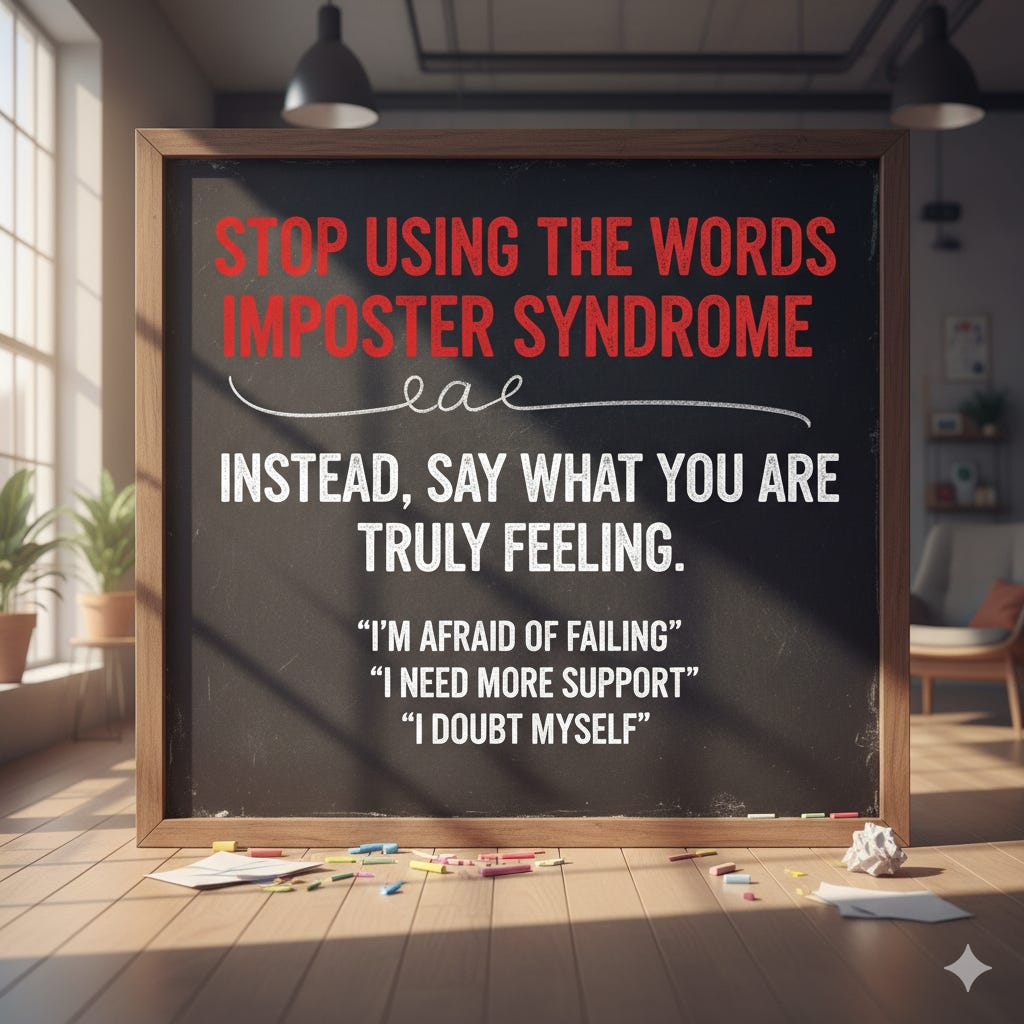
Rethinking “Imposter Syndrome"
Why calling it Imposter Syndrome Hurts More Than It Helps

Have you heard of the concept called the imposter syndrome? I had not heard about it until a few years ago even though it has been around for awhile.
It’s that nagging voice in your head that whispers:
“I don’t belong here.”
“I’m not good enough.”
“Everyone else has it figured out except me.”
It’s a term that gets tossed around in professional circles, continuing education seminars, and even memes. But what is imposter syndrome really? Where did it come from? And is it really the problem we should be focusing on—or is it just a distraction from deeper issues in our profession?
The Origins of Imposter Syndrome
The term imposter phenomenon was first coined in 1978 by psychologists Pauline Clance and Suzanne Imes. Their research on high-achieving women revealed that many attributed their success to luck, timing, or other people’s misjudgments—rather than their own skill.
Since then, the idea has spread far beyond academia. Today, imposter syndrome is used to describe feelings of inadequacy in nearly every profession. While it resonates with many of us, it’s important to remember:
It was never intended to be a clinical diagnosis.
It arose in a culture where women and marginalized groups were systematically excluded from advancement.
It framed a systemic problem as an individual failing.
Why Imposter Syndrome Hurts Us More Than It Helps
At first glance, identifying with imposter syndrome seems validating: “I feel this way, and it has a name!” But there’s a catch.
When we label our doubts as imposter syndrome, we risk internalizing the idea that the problem is us. That we’re broken, insecure, or need to “fix” our mindset.
For massage therapists, this is especially harmful because:
The profession is undervalued.
We’re often dismissed as “not real healthcare” or confused with illicit businesses. That’s not imposter syndrome—that’s stigma.Our education and licensing are inconsistent.
A therapist in one state may train 500 hours; in another, 1,000+. That inconsistency can make anyone wonder if they measure up.We lack clear professional frameworks.
Unlike nurses or physical therapists, massage doesn’t have universally agreed-upon standards of practice or career ladders. Without them, therapists feel lost.
In other words: the real issue isn’t in our heads. It’s in the structure (or lack thereof) of our profession.
What’s Really Going On Beneath the Surface
When a massage therapist says, “I feel like an imposter,” what they may actually mean is:
“I don’t feel prepared because my school didn’t teach this part of practice.”
“I’m comparing myself to someone who has 20 years in the field.”
“Insurance companies, doctors, and even the media don’t take us seriously.”
“The public confuses my profession with sex work, and I don’t know how to stand tall against that.”
That’s not imposter syndrome. That’s systemic underdevelopment of the massage therapy profession.
How We Can Move Past It
Massage therapists don’t need more confidence hacks or affirmations to “get over” imposter syndrome. What we need is a stronger foundation for professional identity. Here are some steps that help:
1. Shift the Frame
Instead of asking, “What’s wrong with me?” ask:
What’s missing from my training?
What systemic issues are creating this doubt?
This takes the blame off individuals and puts it where it belongs—on a profession that still has growing pains.
2. Build Peer Supervision and Support
Therapists need spaces to share struggles without judgment. Peer supervision groups, mentorship circles, or local meetups can normalize the fact that none of us know everything.
3. Acknowledge Our Strengths
Massage therapists bring something unique to healthcare: time, touch, and presence. Instead of focusing on what we aren’t, let’s highlight what we are.
4. Advocate for Professional Growth
Join efforts to strengthen licensing, continuing competence, and recognition. The stronger the profession, the less room there is for imposters to creep in.
5. Separate Personal Worth from Systemic Flaws
You are not an imposter because the profession lacks a unified practice framework. You are a practitioner doing the best you can within a fragmented system. That distinction matters.
Final Thoughts
Imposter syndrome may feel real, but it’s often a smokescreen. It keeps us focused inward—on self-doubt—instead of outward, on the real barriers holding massage therapy back.
Massage therapists don’t need to “cure” imposter syndrome. We need to:
Build stronger educational standards.
Create clear professional pathways.
Push for recognition in healthcare.
Support each other as peers, not competitors.
When we stop blaming ourselves and start addressing the real issues, the voice of the imposter will fade—not because we silenced it, but because we no longer need it.
✨ Massage therapy isn’t an imposter profession. It’s an emerging one. And we are the ones shaping its future.
Understanding Imposter Feelings in Massage Therapy
Massage therapists often use the term “imposter syndrome” to describe a persistent self-doubt in their professional lives. It refers to feeling like a fraud – believing you don’t truly belong or aren’t as competent as others think, with a lurking fear of being “found out” (abmp.com). For example, a recent massage school graduate might fear her first client will demand a refund, despite excellent training, or an experienced therapist might forget a muscle’s name and suddenly feel like a phony (massagemag.com). Such episodes illustrate the classic impostor phenomenon: even skilled, caring practitioners can internally discount their expertise. These feelings are surprisingly common – an estimated 70% of people experience impostor moments at some point, and massage professionals are no exception. Understanding what fuels these feelings is the first step toward addressing them.
Root Causes: Psychological, Emotional, and Systemic Factors
Perfectionism and Self-Doubt: Many massage therapists are high achievers who set very high standards for their work. Traits like perfectionism and a low sense of self-efficacy are strongly linked to imposter feelings (massagemag.com). Therapists who believe they must always perform at 100% may interpret any minor mistake or knowledge gap as proof they’re not good enough. Fear of failure and performance anxiety further feed this cycle. As clinical psychologist Jessamy Hibberd notes, perfectionists often fear failure, yet “failure is not a bad thing…mistakes and failures are necessary for learning” (massagemag.com). Without reframing these beliefs, a massage therapist may chronically downplay successes and fixate on flaws, thus perpetuating the internal narrative of being inadequate or “fake.” Over time, this mindset can hinder professional growth and confidence.
Burnout and Emotional Labor: The nature of massage therapy – a caring, hands-on helping profession – makes therapists uniquely prone to burnout and emotional exhaustion. The work is not only physically demanding but also emotionally taxing. Practitioners constantly give energy and empathy to clients in pain or stress, which can drain their own reserves (amtamassage.org). In fact, working with the public can be deeply draining: a massage therapist may spend the day juggling appointment schedules, client emotions, and service issues on top of the intense physical work of massage. Over time, this can lead to “emotional and mental fatigue,” where one’s motivation and confidence plummet. Burnout and impostor feelings often reinforce each other. One type of burnout, “neglect burnout,” is closely linked to imposter syndrome – it is marked by helplessness, hopelessness, and the sense of “I can’t do this” at work (amtamassage.org). In other words, an exhausted therapist may start believing they are failing or unworthy, when in reality they are depleted. This chronic fatigue and cynicism warps their self-perception, making them feel like an impostor who isn’t cut out for the job. Burnout-related imposter thoughts are essentially a distress signal, indicating the therapist has been overstretched emotionally or physically.
Massage therapists can experience intense emotional and physical exhaustion. Constantly caring for others without adequate rest or support may lead to burnout – a state of chronic fatigue, cynicism, and reduced self-confidence(amtamassage.org). Such burnout can make even skilled therapists feel ineffective or “fraudulent” in their roles.
Undervaluation and Lack of Recognition: Beyond personal traits, systemic factors in the massage profession play a huge role in imposter feelings. Massage therapy is often undervalued and misunderstood in the broader healthcare landscape. Despite rigorous training and proven therapeutic outcomes, many massage therapists feel “relegated to the margins of legitimate health care” markmagazine.co.uk. For instance, highly qualified clinical massage specialists may find themselves lumped together with unlicensed or beauty-focused services, with no distinction for their expertise This lack of professional recognition sends a demoralizing message that their work is “not real healthcare,” which practitioners can internalize as self-doubt. As one report noted, the market often undervalues expertise, driving down pricing and status for even the most skilled therapistsmarkmagazine.co.uk. Therapists who struggle to earn fair wages or respect may begin to question their own value, wondering if they truly deserve to call themselves professionals. Moreover, within some workplace cultures, massage therapists receive little feedback or reward – “lack of recognition or reward” can leave them feeling irrelevant and pointlessinsurebodywork.com. In environments where colleagues or medical providers do not fully respect their role, a massage therapist can start to feel like an impostor among “real” healthcare providers.
Bias and Systemic Pressures: It’s also important to acknowledge the impact of discrimination and bias, as these can underlie impostor feelings. Therapists from marginalized groups (e.g. women, BIPOC, LGBTQ+ individuals, or even men in a female-majority field) often face subtle undermining or questioning of their legitimacy. Over years, such toxic experiences accumulate and erode self-confidence. “Increased self-doubt and a feeling of ‘not belonging’ are natural responses to years of being undermined, undervalued, and intentionally excluded in work environments,” writes massage-therapist-turned-psychotherapist Rowan Blaisdellabmp.com. In other words, what some call impostor syndrome may actually be an internalization of external biases. For example, if a spa or clinic culture consistently favors certain personalities or backgrounds, those who don’t fit the mold can feel out of place no matter how competent they are. This context is crucial: a therapist’s self-doubt might say less about their actual abilities and more about how unsupported or unseen they have been by the systems around them. When the industry undervalues massage as a whole and a workplace fails to celebrate individual contributions, the fertile ground for impostor feelings is laid.
Why Calling It “Imposter Syndrome” Can Be Misleading
While “imposter syndrome” is a popular label, massage experts and psychologists caution that the term can be reductive – it places the blame on individuals’ psyches without addressing context. First, “syndrome” implies a personal pathology, yet impostor feelings are not a clinical diagnosis at all, but a common phenomenon. Labeling a massage therapist’s very real doubts as a “syndrome” might trivialize or medicalize what could be a valid reaction to difficult circumstances. For instance, consider a therapist who feels insecure about performing a new technique. Is she truly an “impostor,” or is she exercising prudent caution due to limited experience? In such cases, doubt isn’t a flaw – it’s good judgment. By contrast, true impostor syndrome tends to be pervasive and irrational, holding capable people back even when there’s no real cause for alarm.
Another concern is that the impostor syndrome narrative overlooks systemic problems. Telling an overworked, underpaid massage therapist that she “just has impostor syndrome” can sound like the issue is entirely internal – as if she simply needs more confidence. This misses the point if her feelings of inadequacy stem from burnout or lack of support. In fact, researchers and equity experts argue that we should “stop telling women they have imposter syndrome” when the real issue is a biased work culture. The same applies in massage therapy: a practitioner who has been subject to dismissive doctors or toxic managers may be having a normal response to past microaggressions and trauma, not an irrational fear. By slapping the impostor label on every instance of self-doubt, we risk pathologizing legitimate feelings and lived experiences. It can be profoundly counterproductive if a therapist feels blamed for their own insecurity (“Why can’t I just get over this?”) rather than understood. We must carefully ask ourselves: “Is it impostor syndrome, or what am I really feeling and needing?”. This reframing shifts the focus from personal failing to a broader perspective, validating that the problem might not originate solely within the therapist.
Finally, the catch-all use of “imposter syndrome” can prevent nuance. Not all self-doubt is bad – a dose of humility keeps practitioners learning and improving. On the flip side, the absence of any doubt (an excess of ego) can be dangerous in a health profession. Thus, instead of rushing to “cure impostor syndrome” in every therapist, it’s more useful to discern when the feeling is truly excessive versus when it’s a sign you care about doing good work. In short, the term “imposter syndrome” may oversimplify a complex interplay of personal and professional factors. Massage therapists benefit from a more nuanced view of their inner critic – one that recognizes external causes and the occasional wisdom in self-doubt.
Reframing the Experience and Supporting Therapists
Rather than branding themselves “impostors,” massage therapists can find more supportive ways to understand and talk about these feelings. One approach is to use gentler language like “impostor phenomenon” or “impostor feelings,” which acknowledges the experience without suggesting a fixed illness. Even more simply, therapists can refer to it as professional self-doubt or a crisis of confidence. These phrases validate the feeling while leaving room to address its causes. Indeed, many experts now encourage reframing the narrative: what if you’re not an “impostor” at all, but a competent professional who is learning, growing, or facing a tough environment? This shift in mindset can be empowering. For example, if you find yourself thinking “I’m a fraud; I don’t know enough,” try reframing it as “I’m in a learning curve, and it’s normal to not know everything yet.” If the thought is “I’m not a real healthcare provider,” consider that “my profession is still gaining recognition, but I make a real difference for my clients.” By naming the feeling more accurately – as exhaustion, as uncertainty in a new situation, or as a reaction to past bias – therapists can address the true issue instead of berating themselves.
In tandem with reframing the language, there are concrete steps to support massage professionals struggling with these feelings:
Normalize and Share Experiences: It helps to know you’re not alone. Impostor feelings thrive in silence and shame. Opening up to trusted colleagues or in professional forums can reduce the stigma. In fact, many massage therapists report relief in learning that thousands of their peers have similar doubts. Talking openly about these challenges – much like we discuss physical self-care – validates that this is a common human experience, not a personal failing.
Seek Mentorship and Feedback: A supportive mentor or peer group can provide perspective. Often, an outside eye will recognize your skills and progress more readily than you do. Don’t hesitate to reach out to an experienced colleague or instructor for guidance and encouragement. Positive feedback and reassurance from others in the field can counteract the distorted self-image impostor feelings create. Likewise, supervision or skill-refresher courses can boost confidence by solidifying one’s sense of competence.
Address Burnout Proactively: Because burnout and impostor feelings are so interconnected, tackling burnout can greatly alleviate feelings of inadequacy. Prioritize self-care and balance as non-negotiable parts of your career. This might mean setting limits on your schedule to ensure you get adequate rest and recovery. Regular physical self-care (stretching, exercise) and emotional self-care (mindfulness, hobbies, time off) rebuild the resilience needed to view yourself in a fair light. If you’re chronically exhausted, remind yourself that feeling ineffective may be a symptom of fatigue, not evidence of fraudulence. Sometimes the best remedy is to take a step back, as one coach advises: “Take some time off for rest…come back in with excitement and feel that joy again”, rather than forcing yourself through burnout.
Challenge Unrealistic Expectations: Make a conscious effort to “kick perfectionism to the curb.” Set reasonable standards and celebrate incremental improvements. One massage therapist shared that updating her résumé and seeing all she had accomplished was a huge confidence booster. Listing your wins – client testimonials, new techniques learned, even small daily successes – can create an evidence bank against impostor thoughts. When self-doubt creeps in, review this list to remind yourself of your skills and positive outcomes. Embrace mistakes as learning opportunities rather than proof of unworthiness. Each time you try a new modality or work with a challenging case, view it as building your expertise (even if it’s a bit messy at first) rather than “faking it.”
Find Meaning and Reconnect with Purpose: Feelings of fraudulence often shrink when you shift focus from yourself to the value you provide. Take stock of the meaningful impacts you’ve had – the clients whose pain you eased or whose stress you relieved. Reminding yourself why you do this work and whom it helps can combat the sense of pointlessness that lack of recognition breeds. Some therapists keep a journal of client breakthroughs or thank-you notes for this reason. By anchoring in purpose, you reinforce that you do earn your place in this profession every day through compassionate service, even if external accolades are rare.
Professional Development and Communities: Engaging in continuing education or massage therapy networks can bolster confidence and counter isolation. Building new skills can replace feelings of “I don’t know enough” with excitement about growth. Additionally, participating in professional associations or online communities (like massage therapy forums or local meet-ups) provides a sense of belonging in the field. A strong professional community can fill the gap if your workplace is unsupportive. Peers can validate struggles and share coping strategies unique to bodywork and caregiving professions. Knowing that respected figures in the industry also sometimes feel insecure (as they often openly admit) helps put your own feelings in perspective.
Mental Health Support: If impostor feelings are overwhelming or tied to deeper issues (such as past traumas or anxiety), seeking help from a mental health professional can be very beneficial. Therapists experienced in caregiver stress or imposter phenomenon can help unpack these thought patterns. As one article advised, help from a mental health-care provider or career coach may be in order when grappling with issues of belonging stemming from toxic experiences. There is no shame in getting support to rebuild one’s self-esteem. Sometimes a few counseling sessions can equip you with cognitive tools to challenge negative self-talk and develop a more compassionate inner voice.
In reframing these internal experiences, the key is compassion and context. Massage therapists should remember that doubting oneself at times is normal – even healthy – especially in a profession defined by empathy and continual learning. Rather than viewing it as a fixed “syndrome,” it can be more helpful to see impostor feelings as signals. They might be signaling that you care deeply about doing good work, that you’re stretched too thin and need care yourself, or that you’re in an environment that needs change. By identifying the root causes – whether personal perfectionism or systemic undervaluation – therapists can address the true issues behind “impostor syndrome.” As we shift the narrative from “What’s wrong with me?” to “Why do I feel this way and what do I need?”, massage professionals can move toward a more supportive and accurate understanding of their experience. This empowers them to seek the validation, rest, or systemic changes required, rather than simply slapping on a label and struggling in silence. In the end, massage therapists are not “impostors” – they are dedicated caregivers who deserve both internal and external support to thrive in their essential work. With the right framing and resources, those nagging feelings of being a fraud can give way to a grounded confidence and a recognition of one’s true professional worth.
Reframing our self-critic
1. “My schedule isn’t full… maybe I’m not good enough.”
Turnaround:
→ A slow schedule doesn’t equal lack of skill—it means marketing or networking needs attention.
→ Action: Reach out to one past client today with a simple check-in message instead of doubting your abilities.
2. “I’m not as fit or ‘spa-perfect’ looking as other therapists.”
Turnaround:
→ Clients come for care, not for a beauty contest. Your presence and touch matter far more than appearances.
→ Action: Ask a few loyal clients why they keep coming back—most will name qualities like comfort, safety, and skill.
3. “I shouldn’t speak up at professional meetings—I don’t know enough.”
Turnaround:
→ Your lived experience as a therapist is valid expertise. Silence keeps the profession stuck.
→ Action: Prepare one short question or comment before the meeting, and practice saying it aloud.
4. “Other therapists have big social media followings… I must not be successful.”
Turnaround:
→ Online presence ≠ professional competence. Quiet, consistent therapists build strong practices every day.
→ Action: Post one authentic message (like a client education tip) this week. Small consistency beats comparison.
5. “I can’t remember every muscle origin and insertion—real professionals should know it all.”
Turnaround:
→ Even doctors use references. Memory doesn’t measure worth.
→ Action: Keep an anatomy app or quick reference book at your table. Using tools is smart, not shameful.
6. “If a client doesn’t rebook, I must have done something wrong.”
Turnaround:
→ Clients’ schedules, budgets, and priorities shift. It’s rarely about you.
→ Action: Send a friendly follow-up message thanking them for their visit—sometimes that reminder brings them back.
7. “Because my state requires fewer training hours, I’m less legitimate.”
Turnaround:
→ Your license makes you legitimate. Hours vary widely across states—it’s a policy problem, not a personal one.
→ Action: Join or support advocacy efforts for higher, consistent education standards instead of internalizing the inconsistency.
8. I’ve been struggling a bit with feeling like I’m not good enough as a massage therapist because I can’t always take away my clients’ pain. Sometimes I feel pressure to ‘fix’ everything, but I know massage is only one piece of the puzzle.
That deep need to fix is very complex. In many ways, our profession as a whole is caught up in fixing. The whole process of going to massage school and getting a license is focused on teaching you how to fix.
Our quest for wanting to learn more techniques to find that one perfect method that will ‘fix’ everyone, every time. We want more techniques to hide our insecurity and low self esteem that says we need to be more and know more and have the answer to everything.
Healing happens when we can say “I don’t know” and we can allow the client to come to know their own wholeness. They are a whole person, with whatever malady they have brought to the massage table.
Many of us feel pressure to “fix” every client’s pain. But that urge often comes from a deeper need for control, not from reality. The truth is: not everything is within our power—and that’s okay.
Trying to fix everything can lead to stress, frustration, and feeling like an imposter. What helps is shifting the mindset:
Accept limits → Massage is powerful, but it’s one part of the healing puzzle. No therapist or doctor can take away all pain.
Let go of perfectionism → Your value isn’t measured by making pain disappear, but by supporting the body’s healing process.
Practice detachment → Clients have their own journeys. You can support them, but you can’t control outcomes.
Build awareness → Notice when you slip into “I must fix this” thinking. Pause, breathe, reset.
Refocus inward → Strength comes from setting healthy boundaries, growing your skills, and honoring your scope of practice.
✨ Success as a massage therapist isn’t about “fixing.” It’s about supporting, empowering, and walking alongside clients in their healing process.
Get help working through your feelings of being an imposter by getting regular Supervision sessions or starting your own peer supervision group to get the support you need. See the Call for Clinical Supervision article.